
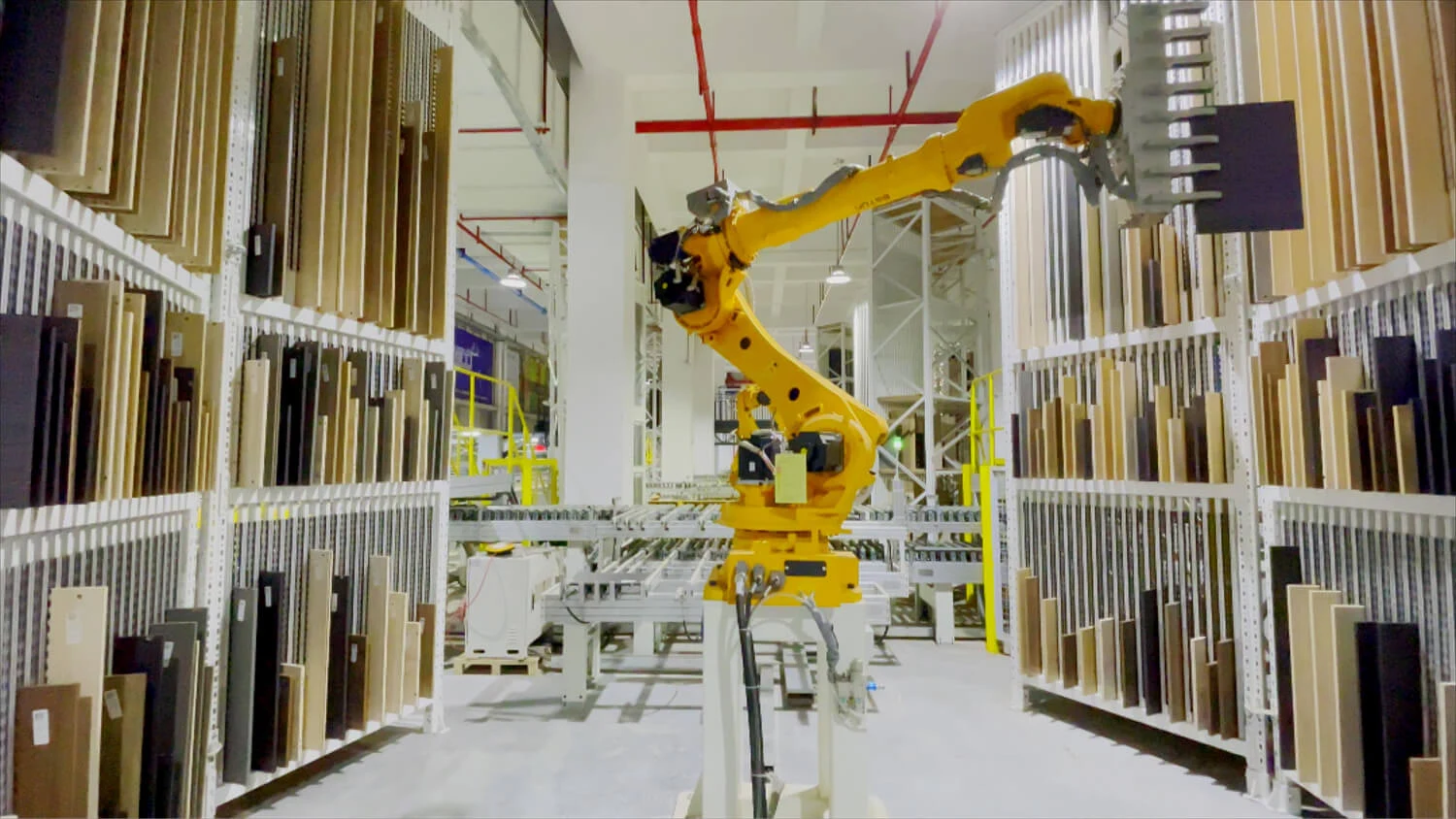
A robot range is best understood through the required motion and environment. This overview links documented ESTUN families to workshop operations. Detailed specifications retain values, variants and sources; the configuration applicable to your project still requires confirmation.
Articulated arms, MINI and heavy payloads
Articulated arms address transfers requiring several workpiece or tool orientations. MINI formats are candidates for certain compact workstations; heavy-payload references address different masses and layouts. Selection must compare accessible positions, rather than only two catalogue numbers.
A larger arm may obstruct access or shift the problem to the gripper. Simulation checks the robot, tool and part through approaches, placement and recovery positions. Inertia and centre of gravity complete the assessment before selecting a reference.
SCARA for planar handling and assembly
The SCARA family is worth comparing for pickup, placement and assembly where geometry suits its working envelope. Selection includes vertical stroke, useful rotation and positions near the base. Stroke and protection versions remain distinct variants.
Rated and maximum payload are not interchangeable. Where specifications distinguish them, both values are retained. Repeatability may also be specified by axis using different units. Cameras, screwdriving and dispensing additionally require their own trials and interfaces.
Industrial palletising and collaborative solutions
Palletisers are assessed against package formats, layer patterns, stack heights and pallet positions. The gripper may handle one package, a group or a slip sheet. Each option changes the carried load, access and sequence. Conveying and pallet removal belong in the requirement.
ESTUN also publishes collaborative arms and a Co-Palletizer system. A complete system should be distinguished from an arm alone: base, any lift, tooling and configuration need identification. A robot’s collaborative designation alone does not determine the protection required for an application.
Welding, bending and stamping
Welding and bending variants serve different requirements. Welding combines torch access, fixtures, parameters and joint inspection. In bending, regripping and press interfaces may determine feasibility before robot payload becomes decisive.
For stamping and transfers between presses, layout and equipment synchronisation need confirmation. An application designation helps identify candidates; it does not prove compatibility with an existing process or finished-part quality. Trials address the selected operations and materials.
Foundry and cleanrooms: qualify the environment
A foundry variant needs assessment against actual splash, temperatures and substances. Main-body and wrist protection ratings may differ. They are not a thermal-resistance declaration. Grippers, cabling and neighbouring equipment need the same assessment.
Cleanroom variants require reference-specific documentation for the intended use. Contradictory source statements remain flagged, without inferring a classification. Food contact, explosive atmospheres and specific cleaning regimes are never assumed from a photograph or a commercial family name.
From catalogue to an integrable configuration
The catalogue presents European references and additions documented by global sources. Inclusion in a brochure guarantees neither stock nor a configuration deliverable in Switzerland. Suffixes, generations, controllers and applicable documentation require confirmation for the proposed equipment; educational cells remain identified as systems.
Compare solutions using the same part, tool and scope. Include interfaces, trials, documentation, instruction and maintenance in the discussion. Vanguard turns those requirements into a reasoned selection and validation points, with manufacturer sources accessible from each specification.